Call us toll free:
+86 755 2306 6423
Shenzhen 3Mtek Innovation Technology Company Limited
Many product businesses face the same challenge.
Their 3D printed product is already selling, but they are not yet ready to commit to very large production quantities.
Does that mean they have to choose between continuing with 3D printing and investing immediately in large-scale production?
Not necessarily.
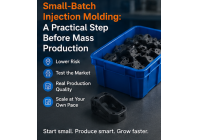
For some products, small-batch injection molding can provide a useful bridge between 3D printing and full-scale production.
3D printing is excellent for low quantities and product development.
However, as order volumes increase, businesses may begin to experience:
Higher labor requirements
Longer production times
Higher cost per unit
Limited printer capacity
Inconsistent output between machines
Difficulty responding to larger orders
Small-batch injection molding can provide an alternative when the product is stable enough for tooling but the business is not yet ready for very large production runs.
A production environment is different from 3D printing.
With injection molding, the actual production material, mold structure, cooling behavior, ejection system, surface finish, and cycle time all become part of the manufacturing process.
Producing a smaller quantity first can help a business evaluate the real product before committing to larger production volumes.
This can be especially useful for products entering a new market or businesses that are still forecasting demand.
You may already know that customers like the product.
But you may still need to answer other questions:
Can we sell 1,000 units?
Can our sales channel support higher volume?
What is the actual production cost?
How much inventory should we hold?
Can our packaging and fulfillment process handle the increase?
Small-batch production can provide useful real-world information before scaling further.
Not every product requires the same tooling strategy.
The appropriate solution depends on factors such as:
Expected production volume
Product size
Material
Geometry
Surface requirements
Required mold life
Future production plans
Budget
This is why tooling should be planned according to the product's actual business requirements rather than simply choosing the most expensive mold option.
The objective of small-batch injection molding should still be consistent, production-quality parts.
The difference is primarily the quantity and tooling strategy—not the expectation that the product should be poorly manufactured.
For businesses transitioning from 3D printing, this can create a more controlled path toward larger production.
For many market-validated products, the manufacturing journey can look like:
3D Printing → DFM → Prototype → Mold → Small-Batch Production → Market Feedback → Larger Production
This approach allows the business to grow production according to actual demand.
There is no universal quantity at which every product should move to injection molding. The right timing depends on the product, demand, unit economics, design stability, and long-term production plan.
The goal is not to produce the largest possible quantity immediately.
The goal is to build a manufacturing process that supports your business at its current stage and can grow with it.
At 3MTEK INNOVATION, we support customers from product design review and prototype development through tooling, small-batch production, and larger-volume injection molding.
If your 3D printed product is already selling and you are considering the next step, small-batch injection molding may be worth evaluating as part of your production strategy.