Call us toll free:
+86 755 2306 6423
Shenzhen 3Mtek Innovation Technology Company Limited
A successful 3D printed product has already passed an important test.
People want it.
Customers are willing to pay for it.
Now the next challenge begins:
How do you turn a product that already sells into a product that can be manufactured efficiently at scale?
This is where the transition from 3D printing to injection molding becomes important.
The starting point is not an idea on paper.
It is an existing, market-validated product.
The manufacturer needs to understand the current product, its function, dimensions, appearance, material requirements, customer expectations, and production history.
This information provides the foundation for the next stage.
The existing 3D printed design may need adjustments before tooling.
The DFM review examines areas such as:
Wall thickness
Draft
Ribs and bosses
Undercuts
Parting lines
Gate locations
Ejection
Material behavior
Cosmetic requirements
The objective is to identify potential problems before mold manufacturing begins.
Sometimes the DFM process identifies opportunities to improve the product.
For example, a feature may be difficult to manufacture, a section may be too weak, or a particular structure may increase tooling complexity.
Instead of simply rejecting the design, the manufacturer can propose alternative solutions.
This is where manufacturing experience can add real value to a product that has already been validated in the market.
Before committing to full production, the revised design can be evaluated through prototypes or samples.
This gives the customer an opportunity to check:
Appearance
Dimensions
Assembly
Function
Fit
User experience
If improvements are needed, they can be addressed before the production process is finalized.
Once the product design has been confirmed, mold design and manufacturing can begin.
The mold becomes the production foundation for the product.
Its design needs to consider the product geometry, material, production quantity, cycle requirements, cooling, ejection, surface finish, and quality expectations.
After the mold is completed, trial samples are produced.
The customer can review the samples and confirm whether the product meets the agreed requirements.
Once the sample is approved, production can move forward.
Depending on the business requirements, production can begin with a smaller batch and later scale to larger quantities.
Mass production is not simply about making a large number of parts.
It is about making the same product consistently.
Quality inspection, production control, packaging, and shipment all become part of the process.
A successful transition therefore connects several stages:
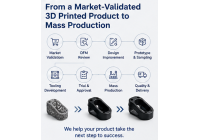
Market Validation → DFM → Design Improvement → Prototype → Tooling → Sampling → Approval → Production → Quality Inspection → Packaging
For a product company, the mold is only one part of the transition.
The real goal is to create a reliable manufacturing path that allows the business to increase production while maintaining product quality and controlling costs.
This is particularly important for small businesses and independent product developers who may not have an internal engineering or manufacturing team.
If your product has already been validated through 3D printing and real customer sales, you have already completed an important part of the journey.
The next question is not whether the product is worth producing.
It is how to build the right production process for its next stage.
At 3MTEK INNOVATION, we help market-validated 3D printed products move toward mold production and injection molding.
From design review and product improvement to prototyping, tooling, sampling, production, quality inspection, and packaging, we work with customers through the manufacturing transition.
Your product is already on the market. We help you build the production path to take it further.