Call us toll free:
+86 755 2306 6423
Shenzhen 3Mtek Innovation Technology Company Limited
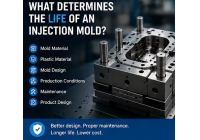
An injection mold is a long-term production tool.
When discussing a new mold, customers often ask:
"How many parts can this mold produce?"
The answer depends on several factors.
Mold life is influenced by the mold materials, product design, plastic material, mold structure, production conditions, maintenance, and the way the tooling is used.
The materials used to manufacture the mold have a major influence on durability.
Different mold steels offer different levels of hardness, wear resistance, corrosion resistance, and machinability.
The appropriate material depends on the expected production volume and the requirements of the application.
A high-volume product may justify a more durable tooling material, while a lower-volume product may not require the same specification.
Not all plastics behave the same way.
Some engineering plastics contain additives or reinforcing materials that can increase wear on mold components.
Certain materials may also require higher processing temperatures or create other demands on the tooling.
Therefore, mold material and product material should be considered together.
A well-designed mold does more than create the correct product shape.
It also needs to manage:
Cooling
Ejection
Mold opening and closing
Material flow
Venting
Moving components
Poorly designed tooling can create unnecessary stress, wear, or production instability.
Good mold design helps the tooling operate more consistently over time.
The way a mold is operated can affect its service life.
Factors such as injection pressure, cycle time, temperature, clamping conditions, and machine setup can all influence tooling performance.
Consistent production conditions help reduce unnecessary stress on the mold.
Even a well-built mold requires maintenance.
Depending on the mold structure and production environment, maintenance may include:
Cleaning
Lubrication
Inspection of moving components
Checking cooling channels
Inspecting ejector systems
Replacing worn components
Regular maintenance can help identify problems before they become major production issues.
A product with a simple geometry may require relatively simple tooling.
A complex product with many moving mold components may naturally create more opportunities for wear.
This is another reason why DFM and mold design should be considered together.
Sometimes a small product design change can simplify the mold structure and reduce long-term tooling complexity.
Not every product needs the same mold life.
A startup producing a few thousand pieces per year may have very different tooling requirements from an established company producing hundreds of thousands of parts.
The objective should be to select a tooling specification that matches the actual business plan.
When evaluating tooling, consider the total production picture:
Mold Investment + Production Cost + Maintenance + Expected Production Volume + Tooling Life
This provides a better understanding of the long-term value of the mold.
At 3MTEK INNOVATION, we consider expected production volume, material, product geometry, and tooling requirements when developing mold solutions.
Our goal is to help customers choose tooling that is appropriate for the product's real production needs—not simply the lowest-cost option.
A good mold should be designed for the production it is expected to support.