Call us toll free:
+86 755 2306 6423
Shenzhen 3Mtek Innovation Technology Company Limited
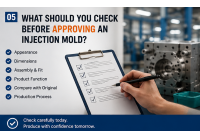
The mold is finished.
The first samples are ready.
Now comes an important question:
Are you ready to approve the mold and move into production?
For businesses that are new to injection molding, it can be difficult to know what should actually be checked.
A professional sample approval process should look at more than appearance.
Start with the basics.
Look at:
Surface finish
Color
Texture
Weld lines
Gate marks
Flash
Sink marks
Scratches
Flow marks
The acceptable cosmetic standard depends on the product and its application.
Not every mark is necessarily a defect, but the agreed cosmetic requirements should be clear before production begins.
The sample should be measured against the approved product drawings or specifications.
Not every dimension needs to have the same level of tolerance.
Identify the dimensions that are critical to:
Assembly
Function
Fit
Movement
Sealing
Appearance
These dimensions deserve particular attention.
A component can meet individual dimensional requirements and still have assembly problems.
If the product contains multiple parts, check:
Does everything fit correctly?
Are snap-fits working?
Are screws or inserts aligned?
Is there excessive movement?
Is assembly too difficult?
Are mating surfaces correct?
Real assembly testing can reveal issues that measurements alone may not show.
This is especially important for market-validated products.
The injection molded version should perform as expected compared with the original product.
Depending on the application, functional testing may include:
Strength
Flexibility
Movement
Load
Repeated use
Connection
Installation
The exact tests should be based on the product's intended use.
If the product was originally developed through 3D printing, keep the original approved version available for comparison.
Ask:
Does the molded product maintain the important characteristics of the original?
Check:
Shape
Size
Appearance
Function
User experience
Some design changes may have been intentionally made during DFM. These should be understood and approved rather than treated as unexpected changes.
Sample approval is also an opportunity to understand how the product will be manufactured.
Questions may include:
What material is being used?
What is the expected cycle time?
What are the key quality control points?
How will cosmetic defects be controlled?
How will parts be inspected?
How will products be packaged?
A clear production plan can reduce misunderstandings later.
Approving a mold sample is an important production milestone.
If an issue is identified, it is generally easier to address it before mass production begins than after thousands of parts have been produced.
A structured approval process can therefore save both time and money.
The customer needs confidence that the product meets expectations.
The manufacturer needs clear confirmation of what has been approved.
That is why sample approval should be based on agreed drawings, samples, specifications, and quality requirements—not simply a quick visual check.
At 3MTEK INNOVATION, we support customers through trial production and sample evaluation before moving into mass production.
Our goal is to make sure the customer understands what is being approved and that the production team has a clear standard to follow.
The best time to find a production problem is before mass production—not after it.