Call us toll free:
+86 755 2306 6423
Shenzhen 3Mtek Innovation Technology Company Limited
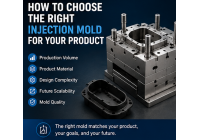
Choosing an injection mold is an important decision when moving a plastic product into production.
For a business that has already validated its product through 3D printing or prototyping, the mold is often the first major manufacturing investment.
The question is not simply, "How much does the mold cost?"
The more important question is:
"Is this the right mold for my product, production volume, and long-term business plan?"
Production quantity is one of the first factors to consider.
A product expected to sell a few thousand pieces per year may require a very different tooling strategy from a product expected to sell hundreds of thousands of pieces.
A higher-volume product may justify a more durable mold and a more automated production setup.
For lower-volume products, a simpler tooling solution may be more appropriate.
The goal is to match the mold investment with realistic production demand.
Different plastics have different processing characteristics.
Material selection can affect:
Mold design
Shrinkage
Cooling
Surface finish
Mold wear
Processing temperature
Product performance
A mold designed for one material may not be ideal for another.
Therefore, material selection should be discussed before the mold design is finalized.
A simple plastic part may require a relatively straightforward mold.
A product with deep structures, undercuts, threads, moving components, or complex cosmetic surfaces may require additional mold mechanisms.
For example, an undercut may require a slider or lifter, while certain internal features may require special tooling solutions.
More complex tooling generally means higher manufacturing cost and potentially longer production time.
A mold should not only solve today's problem.
If you expect the product to grow significantly in the future, it may make sense to consider future production requirements during the initial tooling stage.
Questions worth discussing include:
Will production volume increase?
Will the product have multiple versions?
Will additional products share similar components?
Will the mold need to run for many years?
Will automation be introduced later?
Planning ahead can prevent unnecessary tooling limitations later.
A mold is not simply a metal block used to make plastic parts.
It determines many aspects of the production process, including part consistency, cycle time, ejection, appearance, and long-term production stability.
A low-cost mold may sometimes be suitable for a specific low-volume application.
However, choosing a mold based only on the lowest quotation can create problems if the tooling does not match the actual production requirements.
The best time to discuss mold strategy is before the mold is manufactured.
A professional manufacturer should be able to review your product and explain the relationship between:
Product Design → Mold Structure → Production Volume → Material → Cost
This allows you to understand what you are paying for and why a particular tooling solution is recommended.
There is no single "best" injection mold for every product.
The appropriate tooling solution depends on the product, material, expected volume, quality requirements, budget, and future production plans.