Call us toll free:
+86 755 2306 6423
Shenzhen 3Mtek Innovation Technology Company Limited
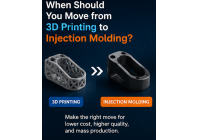
When Should You Move from 3D Printing to Injection Molding?
3D printing is an excellent way to develop, test, and sell plastic products. It allows businesses to produce parts quickly without investing in injection molds, making it especially useful during the early stages of a product's development.
But what happens when your product has already been tested in the market and customers are buying it?
At that point, continuing to produce everything through 3D printing may start to create new challenges. Production time, unit cost, consistency, and scalability can become increasingly important.
This is often the point where injection molding becomes worth considering.
1. Your Product Has Already Been Market Validated
The first question is not simply how many pieces you need.
A more important question is whether your product is already proven in the market.
If customers are buying the product, you understand what they want, and you expect demand to continue growing, investing in a production mold can make more sense than continuing to print every individual part.
A validated product gives you something that a concept does not have: real market feedback.
This makes the transition to injection molding a manufacturing decision rather than simply a product-development experiment.
2. Your Production Volume Is Increasing
3D printing has very low tooling costs, but every additional part still requires printing time, labor, and machine capacity.
Injection molding works differently.
The initial mold investment is higher, but once the mold is ready, the cost per part can become much lower when production volume increases.
The exact crossover point depends on the product, material, geometry, mold design, and production requirements. There is no single quantity that works for every product.
The important question is:
Will the expected production volume justify the investment in tooling?
3. You Need More Consistent Products
When production grows, consistency becomes increasingly important.
Customers expect every product to look and function the same.
Injection molding can provide highly repeatable parts because the same mold cavity is used repeatedly under controlled production conditions.
This can be particularly valuable when your product contains snap-fits, assembly features, critical dimensions, or cosmetic surfaces.
4. You Want to Improve Your Unit Economics
3D printing is flexible, but its unit cost does not usually decrease dramatically simply because you produce more pieces.
Injection molding has a different cost structure.
The mold represents an upfront investment, while the cost of each molded part can become significantly lower as the production quantity increases.
This means that moving to injection molding can be an important step toward improving your product's long-term production economics.
5. Your Product Design Is Stable
One important warning:
Do not rush into tooling before your product is ready.
Injection molding is most suitable when the product design is sufficiently stable.
If you are still changing dimensions, adding features, or testing completely different product structures, 3D printing may remain the better manufacturing method.
Once the product has been validated and the design is relatively stable, the next step is to review whether the design is suitable for injection molding.
This is where DFM—Design for Manufacturing—becomes important.
The Transition Does Not Have to Be a Single Big Step
Moving from 3D printing directly into large-scale production can feel like a major investment.
It doesn't always have to happen that way.
Depending on the product and business plan, you can evaluate:
3D Printing → DFM Review → Prototype / Sample → Mold → Small-Batch Production → Mass Production
This approach allows you to identify potential problems before committing to larger production quantities.
The Real Question Is Not "3D Printing or Injection Molding?"
Both technologies have their place.
3D printing is highly useful for prototypes, design iterations, customized products, and smaller quantities.
Injection molding becomes increasingly attractive when the design is stable, demand is growing, consistency matters, and production volume justifies tooling.
For a market-validated 3D printed product, the goal is not simply to replace one manufacturing method with another.
The goal is to build a reliable path from a product that already sells to a production process that can support its next stage of growth.
At 3MTEK INNOVATION, we help businesses evaluate this transition, improve product designs for molding, develop tooling, and move from 3D printed production to injection molded production.